
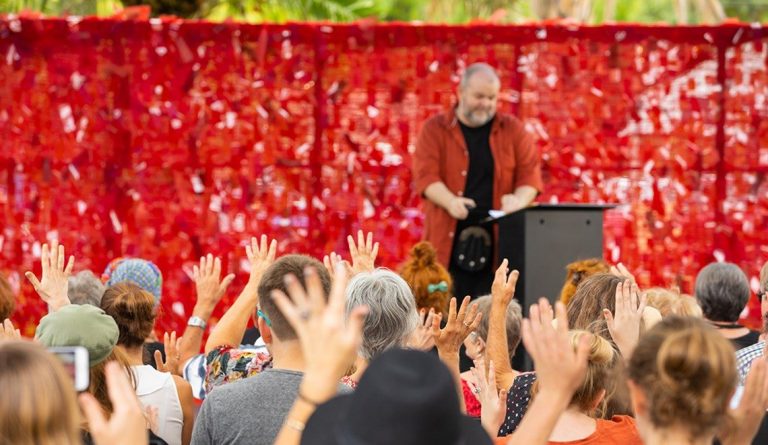
In recent years, there has been increased visibility of Deaf people in public spaces, workplaces, education, and media. Captioning, Auslan interpreters at high-profile events, and accessibility statements on websites have become more common. At first glance, this seems like progress, and it is. Yet beneath the surface lies a persistent disconnect between what institutions consider accessible and what Deaf people experience as inclusive.
There remains a fundamental difference between accessibility as a compliance measure and inclusion as a lived reality. Compliance can be quantified: a caption track added, an interpreter booked, a policy updated. It is an approach that satisfies legal obligations or corporate expectations. Inclusion, however, requires a deeper shift. It demands that Deaf people are not merely accommodated within hearing-designed structures, but are recognised as equal participants, leaders and decision-makers who shape those environments from the outset.
Too often accessibility is addressed at the final moment, a hurried addition to an already-finished plan. Interpreters are positioned in ways that compromise visibility, captions are inaccurate, communication remains directed exclusively at hearing audiences, and the experience provided to Deaf consumers is notably inferior. Each of these instances sends a clear but unintended message: Deaf people were remembered only after everything else was completed. What is framed as inclusion can instead feel like an afterthought.
True inclusion is proactive rather than reactive. It begins with the assumption that Auslan-using individuals will be present, involved, and entitled to equitable access. This means incorporating Deaf perspectives from the very beginning – during design, planning, decision-making and delivery. When Deaf people lead and advise, accessibility becomes embedded rather than applied. Solutions are not speculative; they grow from lived experience and community knowledge. This is where accessibility stops being a checklist and becomes a standard of quality.
Within the Deaf community, inclusion is not simply a service delivered to us — it is a space we actively build. The community is rich in leadership, innovation and resilience precisely because it has had to navigate systems that privilege hearing norms. We do not thrive because hearing structures have made space for us. We thrive because Deaf culture, language and identity remain powerful despite the ongoing pressure to conform to those structures.
Respect for Auslan as a natural language is central to this shift. When Auslan is valued, Deaf people are valued. When Deaf professionals – translators, consultants, educators, artists, advocates – are trusted to lead the work that affects us, outcomes improve dramatically. Quality rises, participation increases, and the community feels ownership rather than obligation.
Ultimately, genuine inclusion relies on a change in mindset. The question is not, “Have we met the minimum accessibility requirements?” but rather, “Have we designed this so Deaf people can participate fully and meaningfully?” It challenges organisations to move away from performative gestures and towards intentional, Deaf-informed practice. It acknowledges that inclusion cannot be achieved by simply replicating hearing experiences; it must respect the linguistic and cultural distinctiveness of Deaf people.
The Deaf community continues to push for environments where accessibility is a foundation, not a modification. We seek systems where Deaf leadership is routine, not exceptional; where our contributions are recognised as essential rather than supplementary. When organisations embrace this philosophy, they do not simply provide access — they create spaces where Deaf people belong.
If the conversation is to progress, hearing-led systems must adopt a new form of listening: not with ears, but with openness. Inclusion will only be realised when Deaf voices are not a late addition, but a starting point.